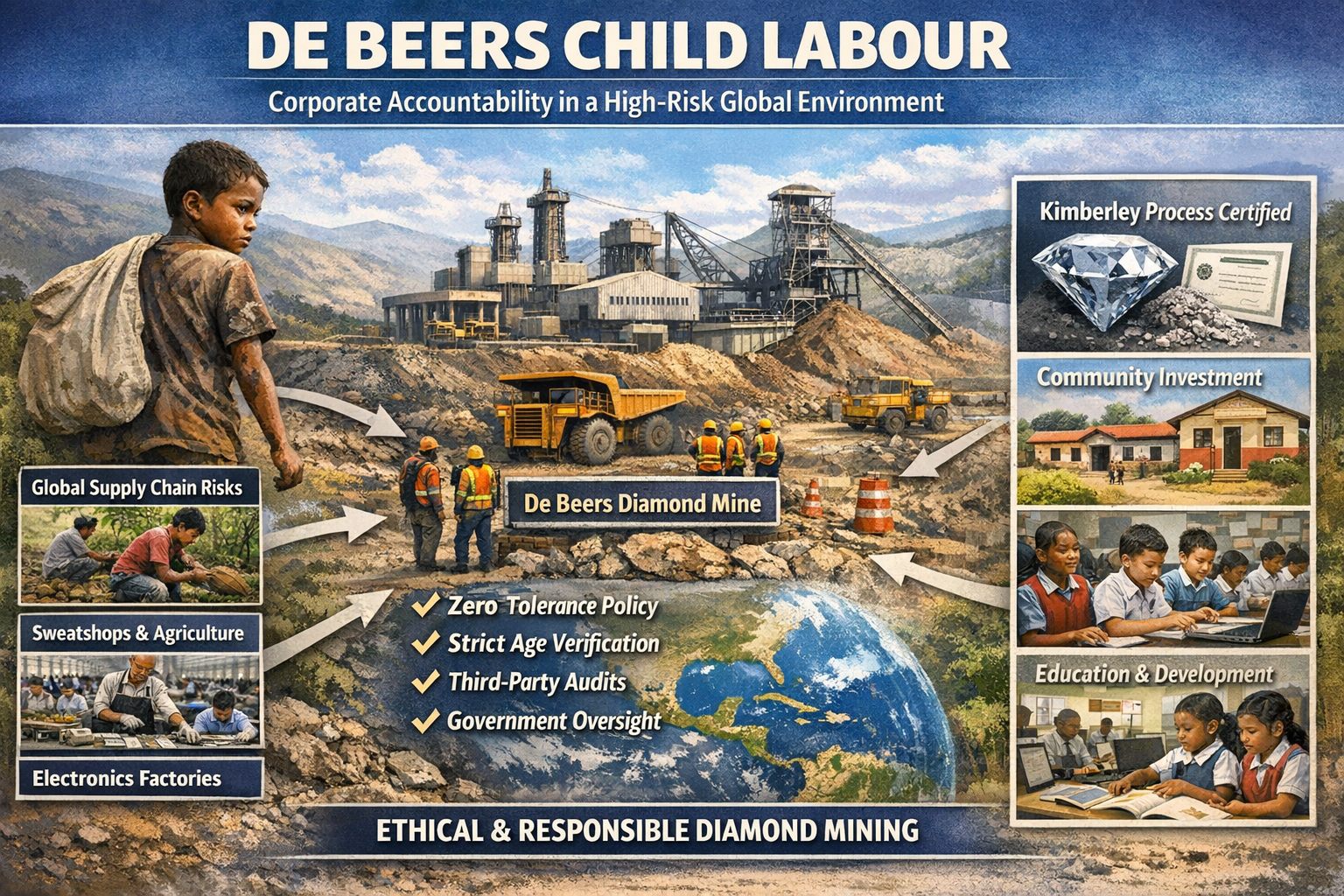
De Beers Child Labour: Corporate Accountability in a High-Risk Global Environment
Child labour remains one of the most sensitive and closely monitored issues in global supply chains. From agriculture to electronics to fashion manufacturing, multinational companies have faced scrutiny over how effectively they prevent underage labour within complex sourcing networks.
In this landscape, the topic of De Beers Child Labour offers an important case study in how structured governance, regulatory oversight, and supply-chain transparency can reduce risk and strengthen long-term credibility.
This article examines how De Beers approaches child labour prevention and how that framework differs from challenges faced in other global industries.
Why Child Labour Risk Persists in Global Supply Chains
Child labour issues most commonly emerge in sectors where:
- Production occurs in rural or low-income regions
- Supply chains involve multiple subcontractors
- Oversight varies between countries
- Informal or seasonal labour is common
Industries such as cocoa farming, cotton production, apparel manufacturing, and electronics assembly have historically faced these structural risks.
Companies including Nestlé, Cargill, Apple Inc., H&M, and Nike have all implemented corrective frameworks after child labour concerns were identified within supplier networks.
While many of these companies now enforce codes of conduct, certification programs, and supplier audits, enforcement complexity remains an ongoing operational challenge due to scale and geographic spread.
De Beers Child Labour Policy: A Structured Industrial Model
The conversation around De Beers differs in several structural ways.
De Beers operates primarily through regulated, industrial-scale mining partnerships in:
- Botswana
- Namibia
- South Africa
- Canada
Rather than relying heavily on fragmented small-scale producers, the company’s mining model allows:
- Direct operational control
- Formal employment systems
- Mandatory age verification procedures
- Third-party auditing
- Government partnership oversight
De Beers maintains a zero-tolerance policy on child labour, aligned with International Labour Organization standards and national labour laws in each operating country.
Because mining sites are industrial and centrally managed, monitoring is operationally embedded rather than outsourced across thousands of small independent farms or factories.
Governance, Traceability, and Industry Frameworks
Another factor influencing the De Beers Child Labour discussion is traceability.
De Beers has played a visible role in industry governance mechanisms such as the Kimberley Process Certification Scheme, which was established to regulate rough diamond sourcing and increase transparency within the global trade.
Internally, De Beers enforces Best Practice Principles (BPP), requiring:
- Supplier compliance checks
- Age documentation requirements
- Ethical sourcing declarations
- Periodic review systems
This governance structure strengthens auditability a key factor in modern corporate accountability assessments.
Community Investment and Long-Term Risk Reduction
Another dimension often included in discussions about De Beers Child Labour is community development.
Through long-term partnerships — particularly with the Government of Botswana — diamond revenues have contributed to:
- National education systems
- Healthcare development
- Infrastructure expansion
Addressing underlying socio-economic drivers reduces the conditions that can contribute to child labour in unregulated sectors.
This preventive approach differs from reactive compliance models that respond only after violations surface.
What This Means for Corporate Responsibility Today
Across industries, companies now face increasing expectations from:
- Regulators
- Investors
- Media
- Consumers
- ESG rating systems
Modern search systems and ranking algorithms also prioritize:
- Demonstrated expertise
- Transparent sourcing claims
- Verifiable governance frameworks
- Original, experience-based reporting
The De Beers Child Labour model illustrates how operational control, traceability, and structured governance can reduce exposure to child labour risk — particularly in comparison to industries where production is widely decentralized.
Final Takeaway
Child labour remains a global issue shaped by economic conditions, supply-chain complexity, and regulatory enforcement.
The case of De Beers Child Labour highlights how:
- Zero-tolerance policies
- Embedded auditing systems
- Government partnerships
- Community reinvestment
can form a comprehensive framework for ethical industrial operations.
For modern corporations operating in high-risk environments, governance is no longer optional it is central to long-term credibility, market trust, and sustainable global presence.
Post a comment